

Ab Separation (Diastasis Recti) Explained

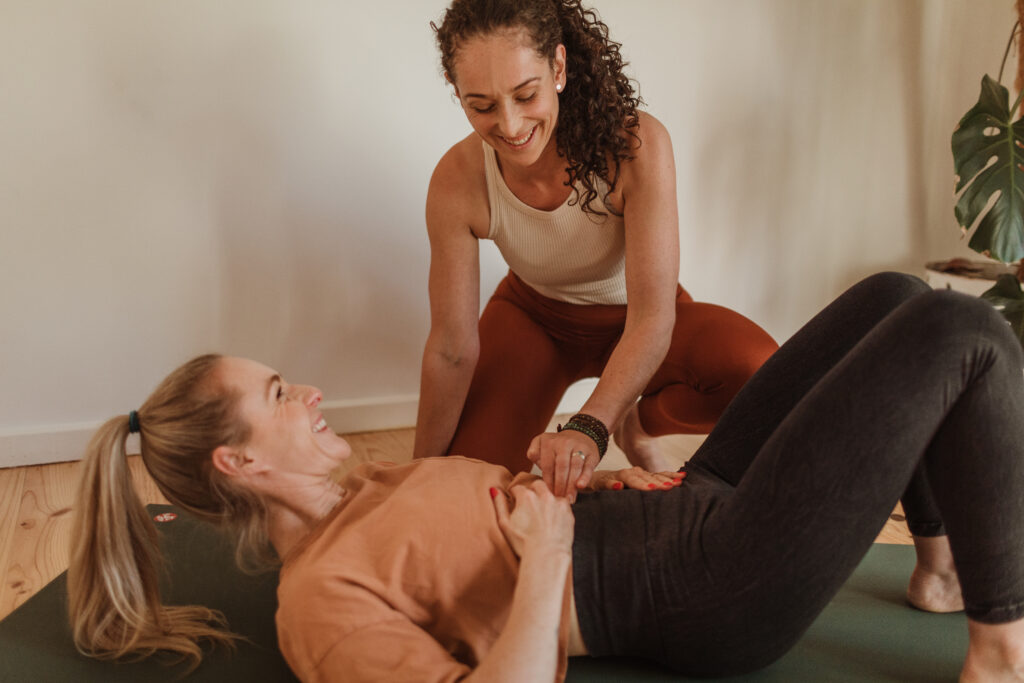
Ab Separation (Diastasis Recti Abdominis) Explained
After both of my pregnancies, I looked at my watery, soft belly and wondered where on earth my core had gone!?
I felt utterly disconnected from my core and pelvic floor, I felt so weak, and couldn’t seem to activate or engage the core much at all.
I wondered if I would ever get this connection back, or see my abs again!?
This is so so normal, as the abdominal muscles have stretched significantly to make room for growing bubba. Diastasis Recti Abdominis (DRA), happens in 100% of full term pregnancies – it is designed that way, but postpartum you can be left feeling like a deflated balloon with no core strength or connection in site. If you feel/felt this way too, you are not alone! Let’s talk about it…
What is your core?
Your core is not just your 6 pack, I like to think of it as a container including:
- Diaphragm at the top
- Pelvic floor at the base,
- Rectus abdominis (the 6 pack) at the front
- Obliques on the side
- Transverse muscles underneath
- Multifidus muscles at the back running along the spine
We can further break these up into deep and superficial muscles. This might sound complex, but take a look at this image below to get more of an idea. Basically, the core wraps around your whole torso, above and below.
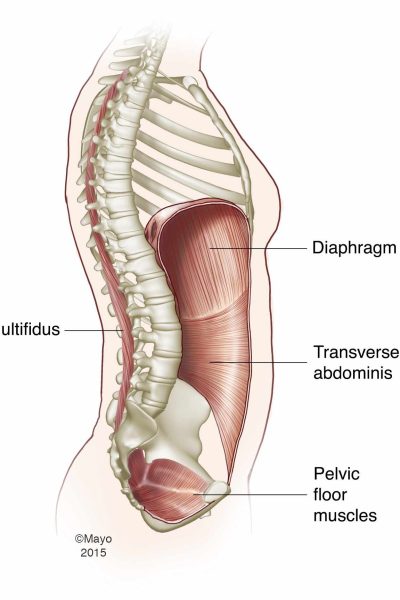
image sourced from: https://chirosportsmed.com.au/core-activation-and-back-pain/
So when we talk about core activation or connection, it involves more than just tightening your abs and sucking in for dear life, it is a whole system that must work together with breath, pelvic floor control and muscle activation.
So what is Diastasis Recti ??
As I mentioned, DRA occurs during pregnancy due to the strain on the connective tissue at the midline of the abs (called the linea alba). Postpartum, it can take time for these tissues to recover.
I like to think of it as blue tack that has been stretched, it doesn’t just spring back into shape immediately. For most, it heals quite naturally, for some women, the separation doesn’t come back on its own, and needs some extra help through exercise, or in some cases with surgery.
There is no clear criteria for diagnosing DRA postpartum, but generally it is classified by a gap of 2.7cm – 3cm or more above or below the belly button, or at the level of the belly button. The depth is also an important consideration, and some research is now saying it is actually more important than width. How far can you push into the abdomen at the midline, and also is there any protrusion (coning or doming) along the midline at rest or when engaging the core.
So determining if DRA is present or actually a problem can be a bit confusing. The increased attention DRA has had lately on social media and the increased awareness of it amongst mums in general is awesome, but has also created fear. Mum’s who might have healed their DRA quite naturally when returning to exercise are now quite scared about having it, and as a result some clients I have worked with are wondering if they should avoid exercise altogether, or just train very “light”.
So what to do (and what not to do?)
How you chose to train during pregnancy and in the early postpartum period will have a big effect on your core recovery.
During Pregnancy
- Learn how to properly activate your core using the breath and core wrapping (baby hugging)
- Modify your training as you progress so as not to overload the connective tissues
- Keep training your core throughout pregnancy (with modifications)
- Incorporate full body functional training that challenges the core
- See a women’s health physio to get specific guidance on your body
- Seek out specialised pregnancy exercise guidance (random videos from YouTube won’t cut it here)
Postpartum
- Start core & pelvic floor reconnection as soon as possible after birth (you can start on day 1!)
- Awareness of your posture (maybe making a few changes here)
- Being mindful of how you are moving through daily tasks (picking up bub, getting in and out of bed)
- Practice your diaphragmatic breathing and core activation regularly
- Follow a program that gets progressively harder to challenge the core tissues
- See your physio to get tailored advice
- As you get stronger, make sure you keep challenging your core and whole body with a progressively harder training program (so many women get stuck on exercises that are too easy)
There is still limited research on the optimal exercises for DRA recovery, but what we do know is that proper breathing mechanics, increasing core strength, the ability to generate tension through the core and incorporating functional movement (think squats, glute bridges, planks) all contribute to DRA prevention and healing.
Here are 3 of my favourite core exercises that all help strengthen the core:
1. All 4s activations + knee hovers (progressions to crawling)
2. Pallof Press Variations
What about crunches & situps?
There is so much fear mongering around certain movements when it comes to the pregnant or postpartum body. You often hear that situps are a big no-no for postpartum mums, and will make your ab separation worse. Is that true?
The truth is that there is very little research on the effect of specific exercises for DRA. The most up to date research that we do have suggests that curl up exercises like crunches do not seem to have a significantly negative impact on a mild-moderate DRA when performed correctly (see the references for these articles below if you are interested).
So as always, the best approach is to actually try things out, and get information from your own body.
A guide to “listening to your body”
We hear this all the time, but what does it actually mean to listen to your body when training the core postpartum (or anything else for that matter).
Listening to your body is a learnt skill. It involves learning how to actually observe for information and cues from your body, and make adjustments accordingly. I came up with this acronym to help myself tune into how to actually do this, and I hope it helps you too.
L.I.S.T.E.N.
L – Level of effort
Tune into how hard your body is working. Can you breathe and talk comfortably? Are you working at an intensity that is right for you? This might mean you need to back off or ramp things up if its too easy.
I – Instincts
Trust your gut. If something doesn’t feel right—even if it “should”—pause or modify.
S – Sensations and signs
Pay attention to physical cues like heaviness, coning/doming, pain, pressure, or leaking. These are your body’s way of communicating with you.
T – Thoughts
Notice your mindset—are you feeling strong and grounded, or pushing through doubt or fear? Your thoughts play a huge role in how you show up in your training.
E – Emotions
How are you feeling emotionally before, during, and after movement? Emotional responses can be just as informative as physical ones.
N – Needs
What do you need today—movement, rest, support, nourishment? Listening means honouring your whole self. If you are exhausted from disturbed sleep it might not be the right choice just to push through. Be honest with yourself.
If you’re postpartum and want a structured program that builds your core and pelvic floor recovery progressively, the Ara Women Rebuild Course was designed for exactly this. You can start from day one postpartum.
REFERENCES
Beamish, N. F., Davenport, M. H., Ali, M. U., Gervais, M. J., Sjwed, T. N., Bains, G., … & Ruchat, S. M. (2025). Impact of postpartum exercise on pelvic floor disorders and diastasis recti abdominis: a systematic review and meta-analysis. British Journal of Sports Medicine, 59(8), 562-575.
Celenay, S. T., Balaban, M., & Kaya, D. O. (2024). Immediate effects of corrective exercise versus curl-up in women with diastasis recti abdominis. Journal of Bodywork and Movement Therapies, 40, 1610-1614
Thabet AA, Alshehri MA. Efficacy of deep core stability exercise program in postpartum women with diastasis recti abdominis: a randomised controlled trial. J Musculoskelet Neuronal Interact. 2019 Mar 1;19(1):62-68. PMID: 30839304; PMCID: PMC6454249.


